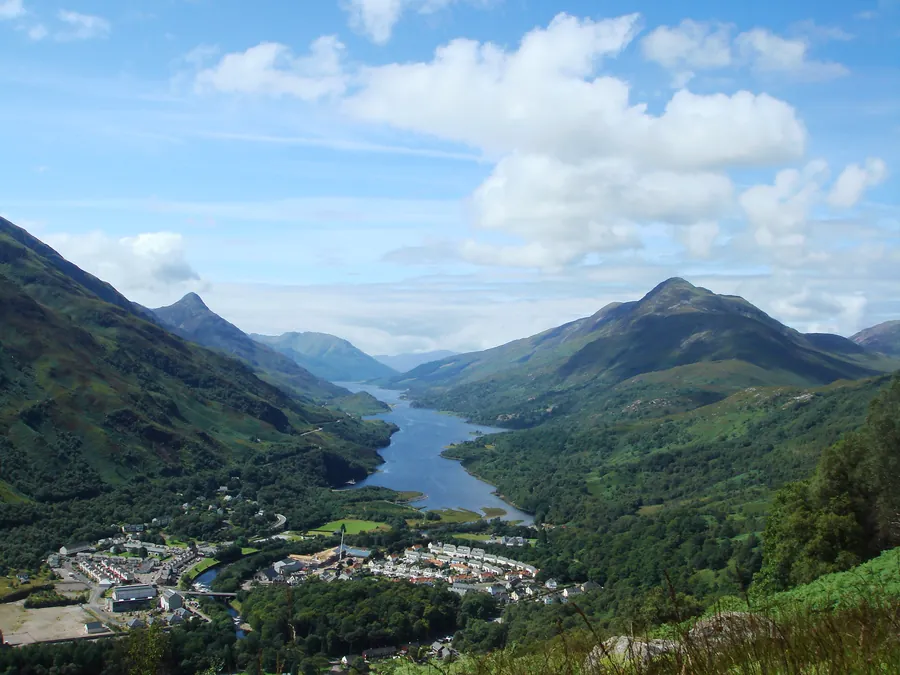
Kinlochleven is a village at the head of Loch Leven, in Lochaber, and it exists because of a factory. An aluminium smelter and the hydroelectric scheme built to run it welded two separate communities into one place: Kinlochmore, north of the River Leven in Inverness-shire, and Kinlochbeg, south of it in Argyll. The scheme also made this the first village in the world with every house connected to electricity, which earned it the name The Electric Village. The smelter closed in June 2000. At the 1991 census the population was just over a thousand, in some 420 households.
What draws people now is the ground above the rooftops. Loch Leven is fjord-like at this end, and the village stands with steep mountains on three sides — the Mamores ridge to the north, the hills flanking Glen Coe to the south. Ten Munros rise in the Mamores above the village, Binnein Mòr the highest, and Wikipedia makes a large claim for the surroundings: more wild mountain land here than in all the mountain national parks of England and Wales combined. Kinlochleven is also the penultimate stop on the West Highland Way, which brings over 85,000 walkers a year past its doors.
The straight-line distance from Fort William town centre is 14.4 km. Wikipedia gives no road distance, and the road does not run direct: the B863 comes round the head of Loch Leven, joining Glencoe to the south-west and North Ballachulish to the north-west. There was no road along the south side of the loch at all until about 1918.
Grey Mare’s Tail Waterfall is the most-reviewed thing in the village by a wide margin, 4.8 from 423 Google reviews, and it asks very little of you. A visitor in July 2026 wrote, “Waterfall very close to the village (around 5 minute walk)”, and from there a longer climb up the hill opens a panorama over the whole village. The approach is a sheltered walk from the car park through woodland, which also means it is not wheelchair accessible. Vehicle size is the other practical catch — a visitor in July 2026 wrote, “Only problem was as a campervan driver finding suitable parking, the walk was certainly worth it - from 2 old fogies - would love to visit again”.
Two viewpoints over the loch are listed separately, both modest: Loch Leven Viewpoint and Picnic Area at 4.9 from 59 Google reviews, Loch Leven Viewpoint at 4.6 from 21. Small samples, and the reviews are clearest about scale — a visitor in June 2026 wrote simply, “Small viewpoint but beautiful”. The wildlife is the better reason to stop at either. Stags walk through the village regularly, white-tailed eagles are seen often and golden eagles in the mountains around it; pine martens, otters, pipistrelle bats and tawny and barn owls are all present, and a hybrid wildcat was filmed in 2018.
For twenty years the answer to a wet day here was the Ice Factor, the National Ice Climbing Centre, built into the old works and opened to the public in 2003, then formally opened by Queen Elizabeth and Prince Philip on 5 June 2005. It held the biggest indoor ice climbing wall in the world and the UK’s highest indoor articulated rock climbing wall.
It closed in March 2023 after a dispute over unpaid rent. Plans to reopen that September came to nothing. In September 2025 it was reported that a community interest company called Point Five might reopen it in 2027. The Google listing still stands at 4.6 from 136 reviews, and reviews left well after the closure still describe the place in the present tense — a visitor in September 2024 wrote, “I love how people find new possibilities for old factory buildings”. Treat that rating as a record of what the centre was, and check before planning a day around it.
What is running is outdoor and guided. Vertical Descents, 4.9 from 51 Google reviews, takes people onto the local via ferrata; a visitor in August 2026 wrote, “Amazing experience with Ben today. Very knowledgeable about the climb and surrounding area”. Otherwise there is a network of mountain biking and hiking trails, a store, ATM banking, the Tailrace Inn, and a micro-brewery in the old coke bunker trading as River Leven Ales.
Work on the dam and water supply began in 1905 and finished in 1907, built for the British Aluminium Company to a design by the engineer brothers Patrick and Charles Meik. The gravity dam is over 914 m long — the longest in the Highlands — and 27 m high, holding back the Blackwater Reservoir at over 305 m in rugged and almost inaccessible ground. It has been described as the last major creation of the traditional navvy.
One of those navvies was Patrick MacGill, who put the site into his novel Children of the Dead End, and some of the incidents in it were real. One morning a worker drove his pick into a rock, struck a buried explosive charge, and the pick was driven into his neck and killed him; it was recorded as happening to an Inverness man in April 1908.
The smelter employed some 700 people in its early days and turned out some of the highest grade aluminium, but it was small beside modern American plants and closed in June 2000. The hydroelectric plant became a general purpose power station on the National Grid, and a visitor centre, The Aluminium Story, sets out how the village came to be.
There is no railway. Kinlochleven was never connected to the network, and the nearest station was at South Ballachulish, renamed in 1908 as Ballachulish (Glencoe) for Kinlochleven.
A scheduled bus or coach link with Fort William is not established here, so the realistic options are the car and your own feet. By road it is the B863 round the head of the loch.
Fort William is the northern end of the 96-mile West Highland Way from Milngavie, and Kinlochleven is its penultimate stop, which makes the stage between the two the last of the walk.
Staying over is common. The hostel, microlodges and campsite sit by the river on Lab Road, in a building that was British Aluminium’s research and testing facility; listed as Blackwater Hostel, Glamping & Campsite, it is 4.2 from 803 Google reviews. Caolasnacon Caravan & Camping Park, on the loch shore, is 4.8 from 515.
The village and what is around it, at walking scale.
Open any of them in Google Maps for directions and current opening.
Attractions, prices and availability in Fort William
These come from GetYourGuide's booking widget, which sets their cookies in your browser. Consent to load it and see the attractions and prices.
Background on Kinlochleven draws on its Wikipedia article, text there being available under CC BY-SA 4.0.