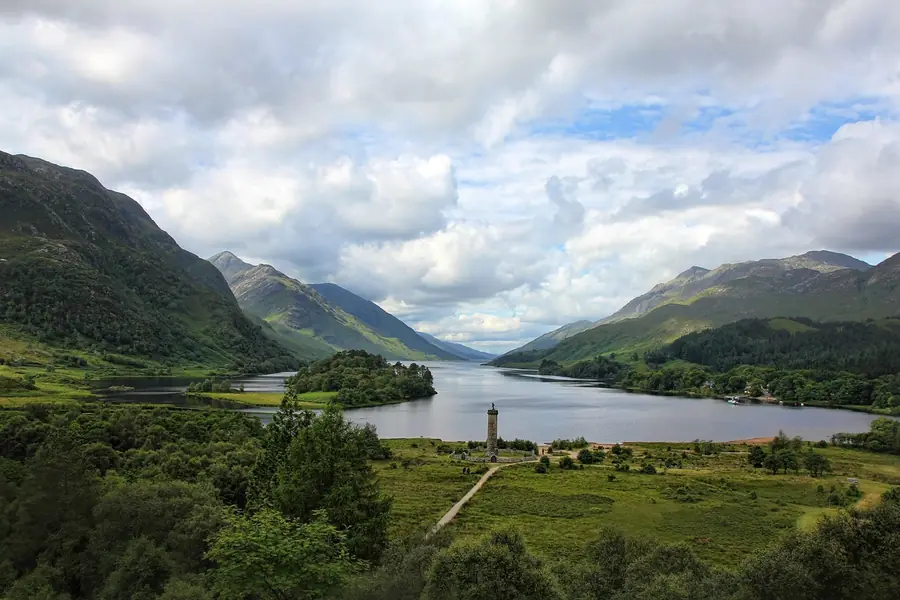
The Glenfinnan Monument stands at the head of Loch Shiel, twenty-one kilometres west of Fort William, and it marks the place where the Jacobite rising of 1745 began.
On 19 August 1745, Charles Edward Stuart raised his father’s standard here, at the meeting point of three glens, and waited to see whether the clans would come. They did — Cameron of Lochiel arrived with several hundred men, and the rising had an army.
The monument was built in 1815 by Alexander Macdonald of Glenaladale: a tall stone tower with a single kilted Highlander on top, unnamed, representing the ordinary men of the clans rather than the prince.
The tower stands on low ground at the water’s edge with Loch Shiel running away south-west between steep hills for nearly thirty kilometres. It is one of the great views in Scotland, and it is the reason the site works: the monument alone would be a column in a field; the monument at the head of that loch is something else.
You can climb the spiral stair inside the tower to the platform below the figure, which visitors say is the right way to experience it — the view from the top is better and the interior is atmospheric. Access is by ticket and timed; the stair is very narrow.
Immediately behind, the Glenfinnan Viaduct carries the West Highland Line across the glen on 21 concrete arches, built by Robert McAlpine between 1897 and 1901 — one of the first major structures in Britain built of mass concrete, which is why it looks the way it does.
It is famous now for other reasons. The Jacobite steam train crosses it, and it appears in the Harry Potter films, which has transformed visitor numbers here.
Train times are displayed in the car park. If you want to see the train on the viaduct, that board is the single most useful thing at Glenfinnan. There are typically two crossings each way on operating days in season.
The viewpoint trail climbs from the visitor centre to a spot looking along the viaduct — about twenty minutes uphill, rough in places.
Glenfinnan has become one of the busiest places in the Highlands, and the car park fills long before the train times. Visitors advise going on a weekday, and going early or late rather than around the crossings.
Out of season, and in the evening, it is a different and much better place.
The site is open; the monument tower and the visitor centre are National Trust for Scotland and charge, free to members.
Parking is charged at the NTS car park, and is enforced. Roadside parking on the A830 is dangerous and heavily discouraged.
Facilities: visitor centre, café, shop, toilets.
Time: an hour, or two with the viewpoint trail and a train.
Access: the ground around the monument is reasonably level; the tower stair is narrow and spiral and the viaduct viewpoint trail is uphill and rough.
Loch Shiel cruises run from the pier below in season.
The Glenfinnan Station Museum, a short distance up the road, is small, free-ish and good.
The road on to Mallaig — the “Road to the Isles” — is among the finest drives in Britain, with the beaches at Arisaig and Morar an hour further west.
Charles Edward Stuart raised the Jacobite standard at Glenfinnan on 19 August 1745, beginning the rising.
An unnamed Highlander, representing the clansmen of the rising rather than the prince himself.
Yes, by ticket — a narrow spiral stair to a platform below the statue.
Times are displayed on a board in the car park; there are typically two crossings each way on operating days in season.
Come on a weekday, and early or late rather than around the train times. The car park fills well before a crossing.