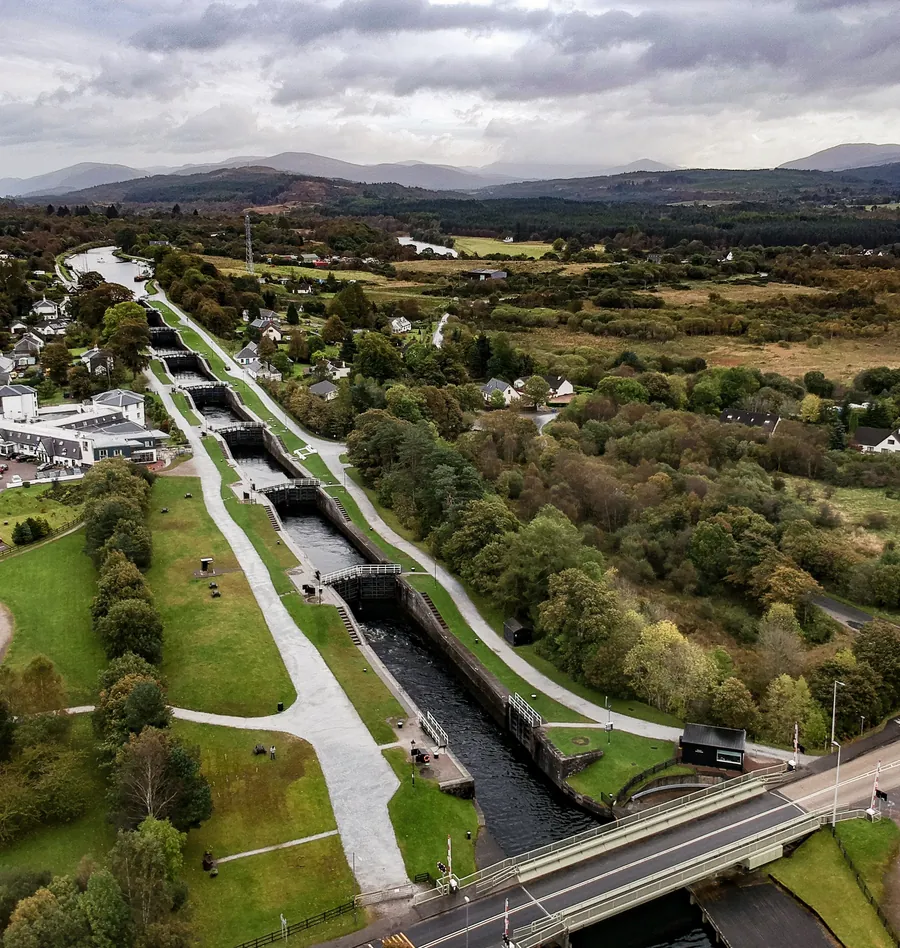
Neptune’s Staircase is a flight of eight locks at Banavie, three kilometres north of Fort William, and it is the longest staircase lock in Britain.
Thomas Telford built it between 1803 and 1822 as part of the Caledonian Canal, and it lifts vessels about 19 metres over a quarter of a mile. It is still in daily working use, and watching it operate is free.
An ordinary flight has a stretch of water between each lock. A staircase has none: the top gate of one chamber is the bottom gate of the next, so the eight locks are joined in an unbroken run up the hillside.
That makes it efficient in space and slow in operation, because every boat has to be raised through all eight chambers in sequence. A full passage takes about ninety minutes to two hours, which is a long time to watch a boat go up a hill and, oddly, not long enough — people who stop for five minutes routinely stay for an hour.
It was originally worked by hand, with capstans, and was converted to hydraulic operation in the 1960s. The lock keepers are on site and, by consistent report, happy to explain what is happening.
The staircase is one end of Telford’s canal, which runs 97 kilometres from Corpach on Loch Linnhe to Inverness on the Moray Firth, using the natural line of the Great Glen and the three lochs in it — Lochy, Oich and Ness.
Only about a third of it is man-made cutting; the rest is loch. It was built to let naval and merchant vessels avoid the passage round Cape Wrath and the Pentland Firth, and by the time it opened in 1822 — twelve years late and vastly over budget — steam power had begun to make the danger it was built to avoid manageable. It never carried the traffic intended, and it survives as one of the great engineering works of the age and a superb cruising route.
The best time is when a boat is going through. There is no timetable, but traffic is heaviest in the sailing season and in the middle of the day; the lock keepers will tell you what is expected. Yachts and small commercial vessels are the usual traffic, sometimes several at once.
The towpath runs alongside the flight and on along the canal in both directions — a level, easy walk, part of the Great Glen Way. West it reaches Corpach and the sea lock in twenty minutes; east it runs up the Great Glen.
The view from the top of the flight is one of the best in the area: Ben Nevis and the Mamores across the canal, and the whole staircase dropping away below.
The railway crosses the canal at the bottom on a swing bridge, and the Jacobite steam train passes over it — a combination of Victorian engineering that photographers make a point of catching.
Free, open at all times.
Parking: a car park near the garage at the bottom, a short walk from the locks, with plenty of space.
Facilities: pubs and cafés at Banavie beside the flight, with outdoor seating overlooking the locks.
Time: thirty minutes, or two hours if something is locking through.
Access: the towpath is level and surfaced and is one of the more accessible attractions in the area.
Eight, in an unbroken staircase, lifting boats about 19 metres.
About ninety minutes to two hours for the full flight.
Yes, entirely, with free parking nearby.
Thomas Telford, between 1803 and 1822, as part of the Caledonian Canal.
Yes — the towpath runs the length of the flight and on along the canal in both directions as part of the Great Glen Way.