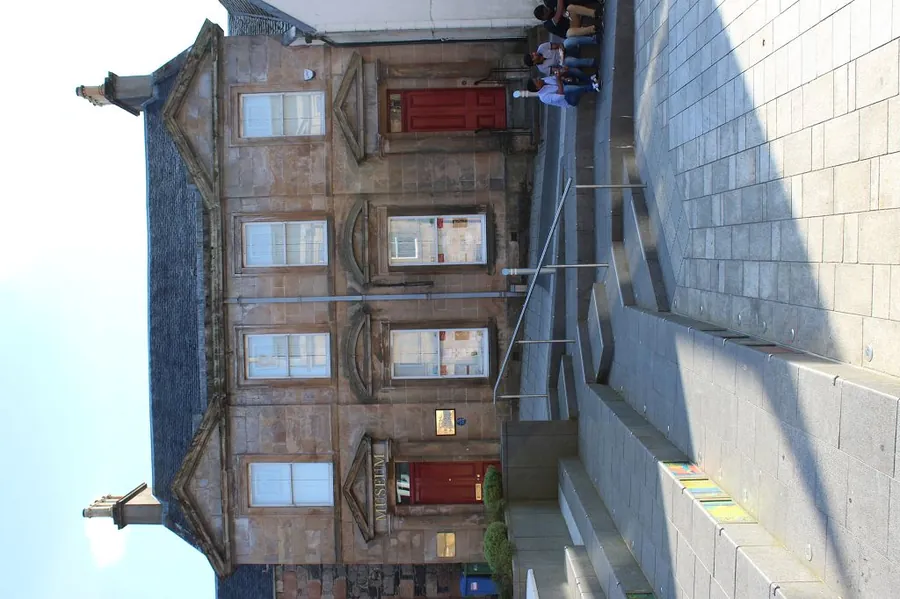
The West Highland Museum — Taigh-tasgaidh na Gàidhealtachd an Iar — stands on Cameron Square in the centre of Fort William, in a listed building, and it is free.
It was founded in 1922 and it aims to cover every aspect of West Highland history: Fort William itself, the Jacobite risings, the clans, the Highland regiments, archaeology, natural history, crofting, and the two world wars.
It is small, densely packed, run largely by volunteers, and it is one of the best small museums in Scotland.
The museum’s most famous object is a plain tray with a smear of unintelligible coloured streaks on it.
Place a polished cylinder at the centre and the distorted image resolves in the curved surface into a portrait of Charles Edward Stuart.
This is an anamorphic painting, made in the years after Culloden when displaying an image of the Prince was treasonable. A Jacobite could have it in plain sight on a table, produce the cylinder among friends to reveal it, and remove the cylinder before anyone else came in. It is a piece of eighteenth-century political survival technology, and there is nothing else quite like it on public display in Britain.
Jacobite material more broadly — this was the heart of Jacobite country, and the collection includes weapons, relics and personal items with strong local provenance.
The Governor’s bed from the old fort of Fort William, the garrison that gave the town its name and was demolished in the 1860s to make way for the railway.
Highland weapons — broadswords, targes, dirks and Lochaber axes — in one of the better regional collections.
Commando material, reflecting the wartime training centre at Achnacarry.
Archaeology and natural history, local maps, crofting life, and the building of the West Highland Line.
The two main rooms carry a great deal, and the explanatory labelling is detailed and well done — several visitors specifically single out the amount of readable information, which is not typical of small museums.
This is a volunteer-run charity and it shows in the good way: people on the desk who know the collection and will talk about it.
Entry is free. The museum runs on donations, membership and the shop, and it asks — reasonably — that visitors who enjoy it put something in the box. Given what is here, that is a fair transaction.
Free, donations invited.
Time: an hour to ninety minutes.
Location: Cameron Square, just off the High Street in the middle of Fort William.
Facilities: shop. No café; the High Street is immediately outside.
Access: it is a historic building on more than one floor; check ahead about lift access.
Opening: typically closed on Sundays and reduced in winter — check before travelling.
Weather: entirely indoors, and consequently the town’s default wet-day plan. In the Highlands that means it is busiest when the weather is worst.
The High Street is pedestrianised and immediately outside.
Old Inverlochy Castle is two kilometres north.
The Jacobite steam train departs from the station five minutes away.
Glen Nevis and the Ben Nevis path start ten minutes out of town.
Yes, with donations invited. It is a volunteer-run charity.
An anamorphic painting of Bonnie Prince Charlie that appears only when a polished cylinder is placed on it — made when owning his likeness was treasonable.
An hour to ninety minutes.
Yes, it is entirely indoors and is the town’s usual wet-day option — which also means it is busiest then.
Cameron Square, just off the High Street in the centre of Fort William.