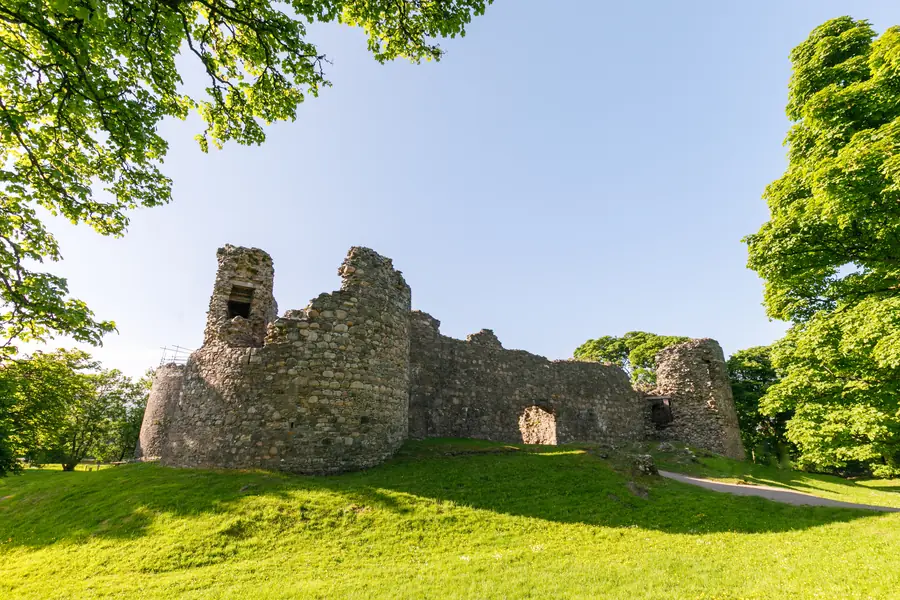
Old Inverlochy Castle stands beside the River Lochy two kilometres north of Fort William, and it is one of the earliest stone castles in Scotland — built in the 1270s, patched at intervals, and very little altered since.
That last point is what makes it historically valuable. Most Scottish castles were rebuilt repeatedly as fashion and artillery changed. Inverlochy was abandoned early enough to escape that, so what stands is essentially a thirteenth-century plan.
A quadrangular courtyard, about 31 by 27 metres, enclosed by a heavy curtain wall with a round tower at each corner.
The largest of the four, the Comyn Tower, served as the keep — a self-contained donjon within the circuit, named for the Comyn family, who were among the most powerful in Scotland before their destruction by Robert the Bruce.
Three sides were protected by a water-filled ditch; the fourth faced the river, which served the same purpose and also gave access — the castle had a water gate allowing supply by boat from Loch Linnhe. Both landward entrances were defended by portcullises.
It is a textbook example of a thirteenth-century courtyard castle, and it is unusual in Scotland for being so plainly readable.
Inverlochy gave its name to two battles fought beside it.
1431: a royal army under the Earls of Mar and Caithness was defeated here by Donald Balloch on behalf of the Lord of the Isles.
1645: Montrose, campaigning for Charles I, marched his army over the winter mountains from Fort Augustus in a move his opponents thought impossible, and fell on the Campbell forces at dawn on 2 February. It was one of the most complete victories of the civil wars in Scotland and one of the most audacious marches in British military history.
The ruins are unstable and the castle is fenced off. You cannot go inside, and this has been the position for several years.
Visitors regularly arrive expecting access and are disappointed, so it is worth being clear: what you get is a walk round the outside of the fence, a view of the walls and towers, and the setting — the river, the mountains and the railway bridge.
That is a pleasant twenty minutes if you are in Fort William anyway, and it is not worth a special journey from a distance. Historic Environment Scotland manages the site; check its website before travelling in case the position has changed.
Free, open ground, no facilities.
Time: twenty to thirty minutes.
Access: a short walk from a small parking area; the ground is grass and can be wet.
Getting there: signposted off the A82 north of Fort William, near the Nevis Range road end. It is walkable from the town in about half an hour, and the Great Glen Way passes nearby.
Inverlochy Castle Hotel, a Victorian mansion of 1863 a little further north, is a different building entirely — a luxury hotel, not a historic site. The medieval castle is the one by the river.
No. The ruins are unstable and the castle has been fenced off for safety. You can walk round the outside.
It was built in the 1270s and is one of the earliest stone castles in Scotland, remarkably unaltered.
Yes — it is open ground with no charge and no facilities.
Two battles were fought here: in 1431 against a royal army, and in 1645 when Montrose surprised a Campbell force after a winter march over the mountains.
Worth twenty minutes if you are in Fort William. Not worth a special trip while access is closed.